what was nicholas IIs response to the revolution of 1905

Tsarism was threatened by the 1905 Revolution but Nicholas II remained staunchly committed to the autocracy. As a result, the events of 1905 were followed by a period of tsarist reaction led by chief minister Pyotr Stolypin, where promised reforms were wound back and revolutionary groups were suppressed.
Retreat, not reform
Nicholas' approval of the Oct Manifesto was largely a surrender to the advice of Sergei Witte and others, rather than a genuine movement towards reform.
Deep in his middle, Nicholas still clung to the outmoded values of autocracy, Orthodoxy and divine right monarchy. The Tsar viewed the October Manifesto and the Duma as a strategic retreat rather than an enduring change.
In the wake of October 1905, Nicholas plotted a counter-attack confronting the reformism that threatened his autocratic power. Men like Witte were sidelined or kept at arm's length as Nicholas filled his ministry and inner circle with conservatives and reactionaries.
In belatedly 1906, the tsar appointed a new chief minister, Pyotr Stolypin, who was to oversee this counter-revolution. Within a twelvemonth, the tsarist reaction had suppressed radical opposition, rigged the Duma and restored its autocratic ability. The changes promised in 1905 were not delivered in full – simply the Russian Revolution was delayed rather than defeated.
Groundwork
On Oct 17th 1905, Nicholas promulgated the October Manifesto. This cursory statement promised Russians an elected legislature (a State Duma) likewise as improved rights and freedoms.
The Oct Manifesto was greeted favourably by conservatives, liberals and some socialists, who favoured moderate reforms and a political system along Western constitutional lines.
The tsar'southward promises failed to ease revolutionary tensions everywhere. Militant socialists, radical workers' groups and mutinous war machine units scattered effectually Russia demanded further reforms and committed to further action against the government.
The Soviet suppressed
With the revolutionaries now divided about their objectives, the tsarist government felt confident plenty to motion against the more radical elements.
In November, the tsar's police arrested 260 members of the St Petersburg Soviet, including Leon Trotsky. Wedlock leaders and strike organisers were also targeted. Eight newspapers in the capital were forcibly closed and several writers and publishers were arrested.
In early Dec, an alliance of Bolsheviks, Mensheviks and Socialist-Revolutionaries launched an ambitious uprising in Moscow, where they stockpiled weapons, blockaded streets, shelled buildings and murdered government officials. The December insurgence was brutally crushed by the tsarist armed forces, which bombarded their sections with rifle fire and heavy arms, killing more than i,000 people.
The Land Duma
The tsar'southward side by side obstruction was the election and convocation of the First State Duma, the elected legislature promised in his October Manifesto.
Elections for the Duma began in March 1906. Voters did not select Duma members directly but voted for electoral colleges (committees that decided on individuals worthy of candidature). All male citizens over the age of 25 were entitled to vote, provided they were not enlisted in the war machine and did not have a criminal tape.
By mid-April, the composition of the 487 Duma seats had been finalised. More than than one-third of the Duma (179 seats) was won past the liberal Constitutional Democrats or Kadets. Left-fly groups similar the Trudoviks (a labour-based party), the SRs and pro-socialist independents occupied more than 150 seats.
The Fundamental Laws
On the eve of the Duma opening, Nicholas issued the Fundamental Laws. This decree was, for all intents and purposes, Russia'southward first written constitution – merely it was also the blueprint for a tsarist reaction.
Rather than codifying the promised changes of 1905, the Fundamental Laws reasserted the principles of autocratic tsarism. Nicholas retained full sovereignty by divine correct; the notion that any of his power was derived from the people was disregarded.
The Tsar alone possessed ramble and legislative ability. Simply the Tsar could modify or modify the constitution. The Tsar also retained the authority to initiate, better or repeal legislative, with or without the endorsement of the Duma. Regime ministers were appointed by the tsar alone; they were not answerable or accountable to the Duma.
Broken promises
This regressive constitution betrayed the promises fabricated the previous year. The October Manifesto had declared an "unshakeable rule that no police force tin can come up into force without approval by the State Duma and representatives of the people".
The Key Laws, however, reneged on this principle, decreeing that all laws were subject to the will and the approval of the tsar.
Privately, Nicholas made no secret of the fact that he thought the Oct Manifesto was a error. It was the product of poor communication from Sergei Witte and others. His own preferred response to 1905 would have been to impose martial law, crush revolutionary elements and air current dorsum rights rather than increase them.
The short-lived First Duma

The Duma met for the offset time on April 27th 1906. With its seats filled with reformists merely its legislative power stripped by the Fundamental Laws, the first Duma before long developed a hostile human relationship with the tsar's government.
Nicholas showed his contempt for the Duma from the outset. Witte's replacement every bit main government minister, a lacklustre bourgeois bureaucrat named Ivan Goremykin, was sent to the bedchamber to submit the tsar'southward offset particular of concern: the construction of a new laundry and greenhouse at a university in Estonia.
The outraged Duma ignored Goremykin'south petty agenda and began debating issues of land reform, armed services funding and constitutional alter. It urged Nicholas to rescind or better the Fundamental Laws, requests he flatly denied.
In July 1906, the Tsar dissolved the Duma and replaced Goremykin with Stolypin, a provincial governor who enjoyed a reputation for effectively quashing political radicalism.
The defiance did not terminate there, withal. Every bit they prepared to depart St Petersburg, 197 Duma deputies signed a petition urging others to defy the tsar and go along meeting in Vyborg, Republic of finland. Many of the signatories to this petition were after persecuted, imprisoned or exiled.
The 2d Duma
Elections for a second Duma were held in January 1907. These elections produced an assembly that was fifty-fifty more than hostile to the tsarist government.
More than than 250 of the 518 deputies were either socialist or aligned with socialist groups. Their number included a block of 65 Social Democrats, Bolsheviks and Mensheviks, who had boycotted the start election. The liberal Kadets occupied another 98 seats.
The second Duma went beyond calls for change to anti-tsarist speeches and accusations. The Duma's 18 Bolshevik deputies did little other than deliver tirades against the tsar, his ministers and other bourgeois elements. Some of these were purposely written by Lenin himself.
The government tolerated this until June 1906 when Stolypin once more dissolved the Duma. He later ordered the arrest of its Menshevik and Bolshevik deputies, accusing them of sabotaging the legislature.
The rigged 3rd Duma
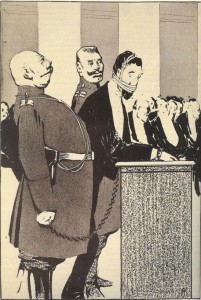
Information technology became clear to the Tsar and his ministers that the Duma could not continue in this fashion. Stolypin ready nearly developing a new electoral police force to keep socialists and radicals out of the sleeping accommodation. If "sane men" are to prevail in the Duma, he later said, then "we don't want professors merely men with roots in the country, the local gentry and and then forth".
After dissolving the second Duma, Stolypin made radical amendments to the balloter law. Some of his changes harked back the 'Bulygin project' of 1905. The number of Duma delegates was trimmed past more than 70 while the franchise (right to vote) was drastically curtailed.
When elections for the third Duma were held in Oct 1907, simply around 3.5 million Russians out of a population of effectually 130 million were eligible to vote. Of the new deputies in the Tertiary Duma, 44 per cent were nobles and virtually 20 per cent were peasants. Socialists, Trudovik and Kadet deputies occupied less than i-fifth of the total seats.
Stolypin's land reforms
Stolypin'due south manipulation of the Duma was not his but idea for consolidating tsarist potency. The chief government minister too had a longer-term vision, based on land reforms and a restructured peasant class.
Stolypin hoped to capitalise Russia's agrestal economic system past providing assistance and incentives to difficult-working peasants ("wager on the stiff" he called this). Encouraging peasants to work for profit rather than landlords or the mir (commune) would revitalise the economy and lead to improvements in farming methods, productivity and output.
The government would aid this procedure by providing aspiring kulaks with banking facilities, loans and assist for purchasing machinery or livestock. A "land banking company" was established to ensure that land was allocated fairly and efficiently, rather than by communes. Minor plots of land would be consolidated and given to successful peasants, rather than to individuals or families barely capable of using them.
These reforms also included measures to open up hitherto undeveloped parts of the empire. Peasants willing to relocate to Siberia, for case, were given government assistance and 40 acres of land.
Pushing through reforms
Stolypin won approvals for these changes by convincing the reluctant tsar that they would eternalize his ability. Breaking the ability of the peasant communes was one objective of the tsarist reaction. A more affluent, contained peasant class would merely strengthen loyalty to the throne, Stolypin argued.
Stolypin's reforms were incentives rather than directives; nigh were not forced on the population. Withal, they encountered significant resistance in several parts of Russia.
Representatives of the communes naturally objected since the reforms threatened both their control of land and the social order in villages. At that place was besides opposition from the state-owning dignity, whose interests, rentals and profits were threatened past whatever significant changes to the peasantry.
Outcomes of 'Stolypinism'
Stolypin's reforms did take some issue but fifty-fifty after a decade, well-nigh aspects of Russia'due south agrarian economy and society remained unchanged.
Between 1906 and 1915, when Stolypin's reforms officially ended, the full land owned by Russian peasants had increased from 4320 1000000 to 4590 one thousand thousand acres, while the tsar's personal country-holdings remained the same. By 1915, more than half the nation's peasants remained in communal state-ownership and only about xv per cent could exist realistically classed equally kulaks.
Stolypin himself did not see his reforms to fruition. After overseeing the tsarist reaction, he was murdered in 1911, the victim of an assassin'south bullet.
A historian's view:
"The tsarist authorities could not settle on a clear-cut policy toward the Duma. They allowed the elections to exist held, they arranged a solemn anniversary to marker the opening of the legislature that enhanced its aura of legitimacy, and they made other gestures that suggested a willingness to cooperate with the new institution. On the other manus, the regime had express the Duma'southward prerogatives before it e'er met, had appointed a prime minister and other ministers hostile to any form of representative government, and in numerous other means had indicated a deep distrust of the legislators, who in turn gave little bear witness of favouring a conciliatory strategy… The human relationship quickly turned acrimonious, condemning the starting time experiment in pop government to an ignominious failure."
Abraham Ascher

ane. Nicholas Two's promised reforms, like those outlined in the October Manifesto in 1905, were followed by a period of tsarist reaction and broken promises.
ii. In April 1906, the Tsar issued the Fundamental Laws, in effect a Russian constitution that maintained and reasserted his autocratic ability.
3. A Land Duma was elected but after the Fundamental Laws had no existent ability. The Duma's hostility to the government led to its dissolution in July 1906.
4. In 1907, main minister Stolypin rigged electoral laws to ensure the tertiary Duma was dominated by conservatives and therefore less hostile.
5. Stolypin also initiated economic and state reforms to facilitate the creation of a kulak course. These affluent peasants would be more productive and become a conservative supporter base of operations for tsarism.
Commendation data
Title: "The tsarist reaction to 1905"
Authors: Jennifer Llewellyn, Michael McConnell, Steve Thompson
Publisher: Alpha History
URL: https://alphahistory.com/russianrevolution/tsarist-reaction/
Date published: July 26, 2019
Engagement accessed: April 09, 2022
Copyright: The content on this page may non be republished without our express permission. For more data on usage, please refer to our Terms of Use.
kellamcommusithad.blogspot.com
Source: https://alphahistory.com/russianrevolution/tsarist-reaction/
0 Response to "what was nicholas IIs response to the revolution of 1905"
Post a Comment